Dryer Repair in Sacramento for Gas and Electric
Tell us gas or electric and how long a load takes to dry. The visit sorts out whether the dryer isn't making heat or can't vent it.
Sacramento Appliance Care lines up dryer repair across Sacramento, Roseville and nearby Placer, El Dorado and Yolo County communities, for gas and electric dryers alike. Some run without heating or need two or three cycles to dry a load. Others squeal or thump as the drum turns, stop partway through, or show a heat or vent code.
In Consumer Reports' 2025 survey of 86,609 dryer owners, not drying was the most reported problem, at 12 percent, ahead of tangled clothes at 10 percent. The cause splits two ways. Either the dryer isn't making heat, or it makes heat that can't get out through a blocked vent. The fix and the cost are far apart, so sorting out which one it is comes first.
No heat
Tracking Down a Dryer That Won't Heat
The first question on the visit is whether the dryer makes heat at all. A cold drum after a few minutes on high heat means the heat circuit has failed. A warm drum with damp loads means heat is being made and trapped, and the vent section below applies.
Electric dryers
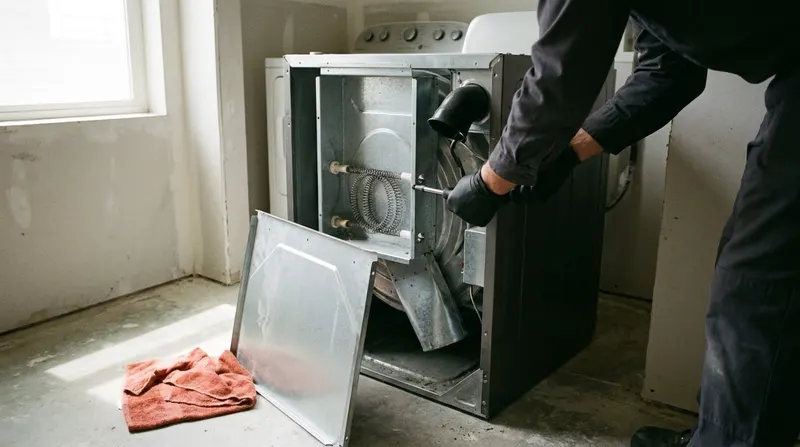
An electric dryer needs a 240-volt supply on its own 30-amp circuit, fused on both sides of the line. Whirlpool and Maytag explain that this means two breakers: one runs the motor that turns the drum and the other runs the heating element. When only one side trips or fails, the drum turns but nothing heats, so both legs of the supply are the first thing to check.
If power is fine, the usual failed parts are the heating element, which can break open like a light bulb filament, and the thermal fuse. The fuse is a one-time safety device that blows when the dryer overheats.
Gas dryers
A gas dryer's burner has an igniter that glows to light the gas and gas valve coils that open to let gas through. A cracked igniter gives no glow at all. Weak coils let the igniter glow, then the flame fails to catch or goes out after a few seconds.
Both are common gas dryer repairs, and both mean working on the gas connection. Ask for a leak test after any gas repair.
Vent and fire safety
Long Dry Times, Clogged Vents and Fire Risk
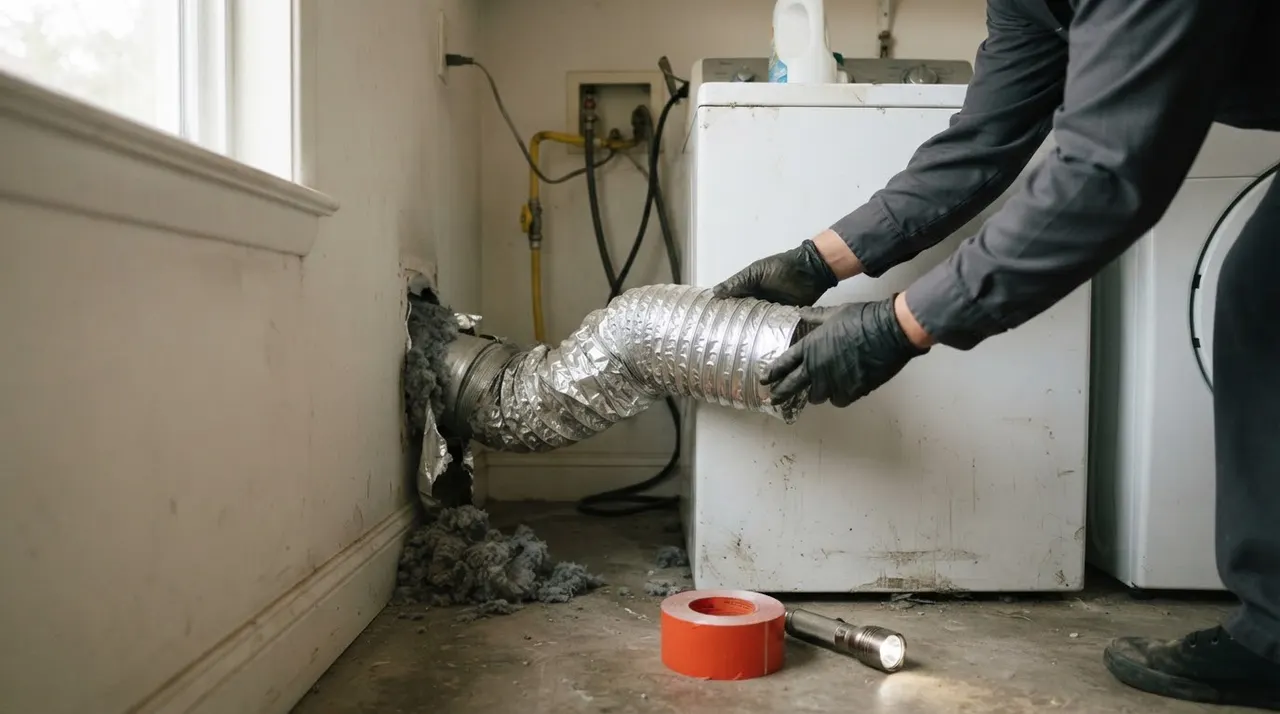
A dryer that heats but still takes forever usually has a vent problem. Whirlpool's venting guide says that if a dryer is heating but still has long dry times, the likely cause is the vent or restricted airflow. Trapped heat also trips the dryer's high-limit safety parts, which is how a clogged vent turns into a no-heat repair.
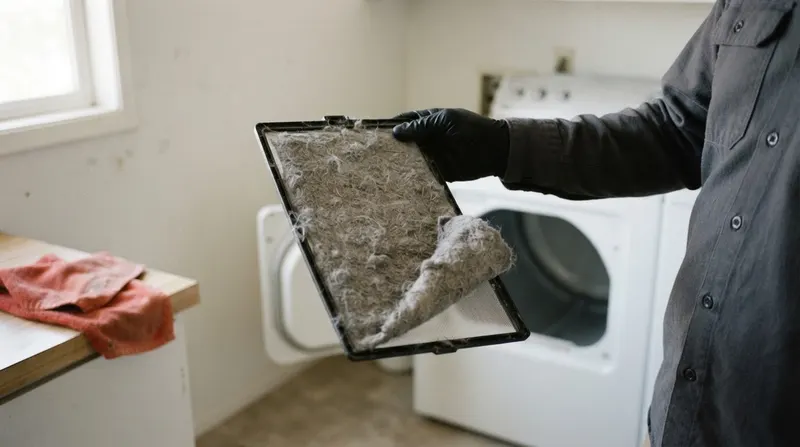
There's a safety reason to deal with it quickly. The U.S. Fire Administration found that failure to clean, at 31 percent, was the leading factor in home clothes dryer fires from 2018 to 2020.
What the tech looks for in the vent
Whirlpool's venting specifications call for 4-inch heavy metal vent, rigid or flexible metal, and warn that foil and plastic vent can collapse or be crushed. Consumer Reports gives the same advice: replace vinyl or foil ducts with metal. The shorter and straighter the run, the better, since length and elbows reduce airflow and collect lint. The outside hood should sit at least 12 inches above the ground and clear of bushes or rocks.
Some Samsung dryers can test their own vent. After the test, C80 means about 80 percent of the vent is clogged and C90 means more than 90 percent, and heat codes such as HC or tS usually trace back to the same lint. Read us the code if you see one.
Tell us about the vent
Where the dryer sits, roughly how long the vent run is, and whether it goes out a side wall or up through the roof. Say whether the duct behind the dryer is foil, plastic or metal, too. A long run in an interior laundry room changes what the tech brings.
- Burning smell or a laundry room that gets hot during a cycle
- Outside flap barely moves while the dryer runs
- Clothes hot to the touch but still damp
- A foil or plastic duct crushed behind the machine
Other symptoms
Noisy, Stopping or Dead: Diagnosing Other Dryer Faults
What you'll notice, what the tech checks on the visit, and the part it usually comes down to.
| What you notice | What the tech checks | Part usually replaced |
|---|---|---|
| Loud squeal that starts with the drum | Whether the squeal happens with an empty drum, then the idler pulley and drum support rollers. | Worn idler pulley or drum support rollers. |
| Thumping on every rotation | The drum for a stuck item, then the rollers and drum glides for flat spots and wear. | Flat-spotted rollers or a worn drum glide. |
| Motor hums, drum does not turn | Whether the drum spins freely by hand, the drive belt and the idler pulley. | Broken drive belt, or a seized idler pulley. |
| Stops partway through the cycle | The lint path and vent for overheating, the high-limit thermostat, the motor and the door switch. | High-limit thermostat, motor or door switch, often with the vent cleared at the same visit. |
| Does nothing when you press Start | Power at the outlet, the door switch, the start switch, the control lock setting and the thermal fuse. | Door switch, start switch, a blown thermal fuse on some models, or the control. |
| Voltage code such as 9C1 on a Samsung | The supply at the outlet and whether an extension cord is in the line. | Usually a supply problem rather than a dryer part. Read us the code when you call. |
Gas and power
Working Safely on a Gas or Electric Dryer
For a repair, the fuel matters more than the brand. A gas dryer adds a burner, an igniter, valve coils and a gas connection to everything an electric dryer has, so there is more to test when it stops heating.
If you smell rotten eggs near the dryer, don't stop to diagnose it. Get everyone out of the house, avoid anything that could spark, including light switches and your phone, and call 911 once you're outside. Once the gas side is safe, call us about the dryer.
Costs
Pricing a Dryer Repair by Fuel and Age
Figures are national survey medians. Nobody publishes Sacramento-only dryer repair prices, so treat these as a yardstick for the written price you get.
| Dryer | Median repair | Why it varies |
|---|---|---|
| Gas dryer under $700 | $116 | Igniters and coils are inexpensive parts. |
| Gas dryer $700 to $900 | $158 | More sensors and electronic controls. |
| Gas dryer over $900 | $200 | Steam and smart models carry pricier boards. |
| Electric dryer under $700 | $118 | Elements, fuses and belts dominate. |
| Electric dryer $700 to $900 | $160 | Moisture sensors and control boards add cost. |
| Electric dryer over $900 | $188 | Brand-specific parts may need ordering. |
| Service call charge | $120 to $170 | Can run higher in large cities and on both coasts. |
From your call to dry towels
-
Tell us about the dryer
Gas or electric, the brand, what it is doing and any code on the display. If the dryer is still under warranty, mention that too.
-
Diagnosis at the dryer
The power or gas supply, the vent and the heat circuit parts get checked. Mention anything you have already noticed, like a tripped breaker or a crushed duct.
-
A written price before the repair
You see the parts and labor in writing and decide whether the repair goes ahead.
-
Your dryer gets fixed
The failed part gets replaced and the dryer heats and tumbles again.
California requires a written estimate before any repair; the Sacramento appliance repair cost guide explains what it covers and compares service call charges across the other appliances in your home.
Repair or replace
When a Dryer Is Worth Replacing
Dryers are simpler than washers and tend to outlast them. A 2007 National Association of Home Builders study listed both gas and electric dryers at 13 years, against 10 for washers. Consumer Reports found that 90 percent of dryers bought between 2015 and 2025 were still in use.
So age alone rarely decides it. Consumer Reports' own examples make the point. A $600 electric dryer bought nine years ago and run seven loads a week isn't worth even a median-priced repair, because the money is better spent on a new, efficient model. A $2,200 dryer that's three years old is worth fixing at its class's median price. Between those, Consumer Reports' long-standing advice applies: don't spend more than half the price of a new dryer to fix an old one.
Belts, rollers, thermal fuses, heating elements and igniters are usually worth fixing on a dryer of almost any age. A failed control board on an inexpensive dryer, or a drum that's rusted or scraping, is more often the moment to replace. The repair or replace guide goes deeper on the 50 percent test.
Brands and areas
Dryer Brands and Covered ZIP Codes
Tell us the brand and model when you call, and whether the dryer is stacked or side by side. Brands include:
The covered list includes 95630 in Folsom, 95624 in Elk Grove, and 95661, 95678 and 95747 in Roseville. The full ZIP list shows every covered area. Don't see your ZIP? Call anyway and we'll check your address.
Washer acting up as well? The washer repair page covers drain, spin and leak problems.
Questions
Before the Dryer Visit
Why does my dryer tumble but not heat?
Because the drum and the heat run on separate circuits, so one can fail while the other keeps working. The no-heat section covers the gas and electric parts involved.
Why does my dryer keep blowing its thermal fuse?
Usually because heat can't escape. A clogged or crushed vent lets the dryer overheat, and the fuse blows to protect it, so a new fuse on its own won't last. Mention a repeat fuse failure when you call so the vent gets looked at too.
Is it worth fixing a 10-year-old dryer?
Usually, unless the fault is a control board on a low-priced model or a rusted drum. The repair-or-replace section explains why.
Do gas dryers cost more to repair than electric ones?
Not by much. Consumer Reports medians for the two sit close together at every price point, as the cost table shows. The bigger difference is the gas connection, which adds work to the repair.
My dryer smells like something is burning. Is it safe to use?
No. Stop the cycle, unplug the dryer and call us. Failure to clean is the leading factor in home dryer fires, as the vent section explains.
Clothes still damp after a full cycle?
Tell us whether it runs on gas or electric and read us the model number from inside the door. We'll set a time for a tech to look at it.
Call (916) 618-0484