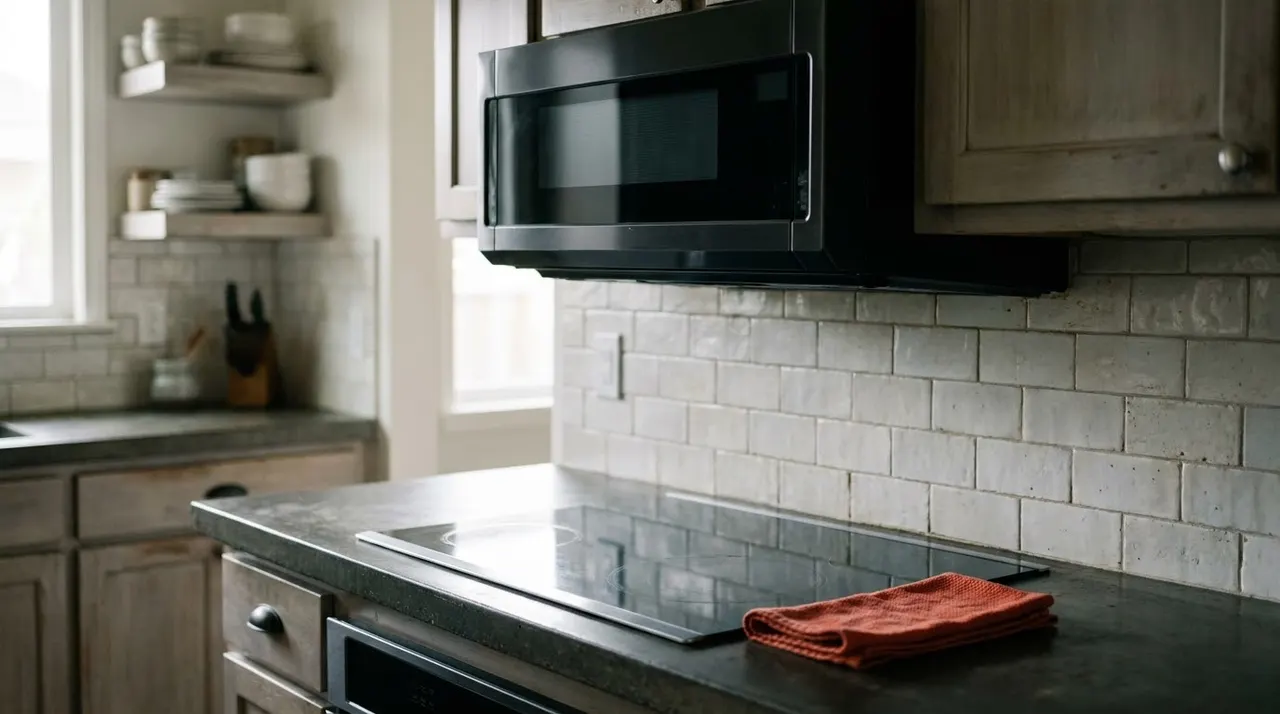
Cooktop and Microwave Repair in Sacramento
Gas, radiant glass and induction each break their own way. Say which one you cook on, and the visit covers the microwave above it too.
Sacramento Appliance Care gets an appliance tech out to gas, radiant glass and induction cooktops, plus built-in and over-the-range microwaves, in kitchens across Sacramento and Roseville. Typical faults include clicking burners, cracked glass, induction burners that won't heat and microwaves that run without heating.
These four appliances share a counter, but they fail for unrelated reasons, and one of them can hurt you if you open it up. If the fault is inside an oven cavity instead, go to oven, range and stove repair.
Stop and read
Staying Safe With a Broken Microwave or a Gas Smell
A microwave stays dangerous after you unplug it
The high-voltage capacitor inside a microwave's cabinet keeps its charge long after the plug is pulled. Consumer Reports warns it can hold thousands of volts for hours or even days, and notes the Consumer Product Safety Commission has recorded electrocution deaths from home repair attempts. Leave the cover on and let the tech open it.
A gas cooktop that smells of gas
Leave the house and get everyone out without touching switches. Call 911 once you're outside.
- Never run a microwave with the door bent, the seal damaged or the latch loose.
- Stop using a microwave if there is a hole in the cavity wall or the interior coating is actively peeling. GE says neither can be repaired.
- Keep liquids off a cracked glass top, and stop cooking on it.
- Don't relight a gas burner that blew out until the gas has had time to clear.
Once the appliance is off and everyone is safe, call us and tell us which of these you're dealing with.
Gas and radiant glass
Diagnosing Gas Burner and Glass Cooktop Problems
Gas burners: clicking, slow lighting, no spark
Most ignition trouble on a gas cooktop starts after a spill or a cleaning. GE traces it to water or food blocking the burner head's ignition port, a burner cap that isn't seated on its matching head, or an electrode pushed out of place. Those are the first things the tech looks at.
If every burner clicks at once and won't stop, the problem usually sits in a shared part: the spark module or a switch behind one knob. A burner that never clicks at all while the others do points to its own switch or electrode wire.
Consumer Reports' member surveys found ignition problems were fixed on the first visit about 72 percent of the time.
Radiant glass: cracks and elements stuck on high
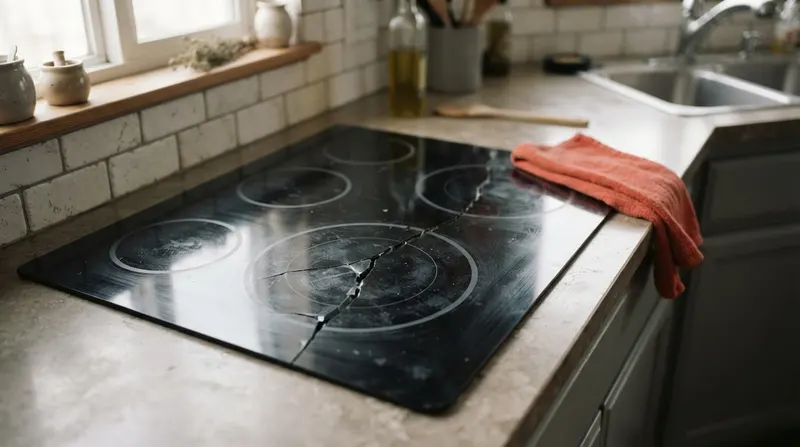
A smooth radiant top has coiled elements under ceramic glass, each run by an infinite switch or a touch control. An element that won't heat usually has a broken coil or a failed switch. One that stays on high after you turn it down has a switch with welded contacts, which needs attention soon because the burner can't be controlled.
Cracked glass is its own category. The whole top is replaced as one panel, and the price depends on the brand, whether the glass is still made and whether the touch controls are part of the glass assembly.
Induction
Induction Cooktop Faults and What Gets Checked
- The supply voltage at the cooktop.
- The induction generator (power) board behind the faulty burner.
- The cooling fan that keeps the boards from overheating.
- The touch control and its ribbon connection.
An induction burner heats the pan directly through a magnetic field, and the electronics that make that field run hot. When cookware that worked before won't heat, or one burner quits while the others carry on, the fault is in the cooktop.
The checks start with the power reaching the cooktop and work in toward the boards. Induction parts are expensive, which is why Consumer Reports' median induction repair is more than triple a gas one.
Microwaves
Over-the-Range and Built-In Microwave Repair
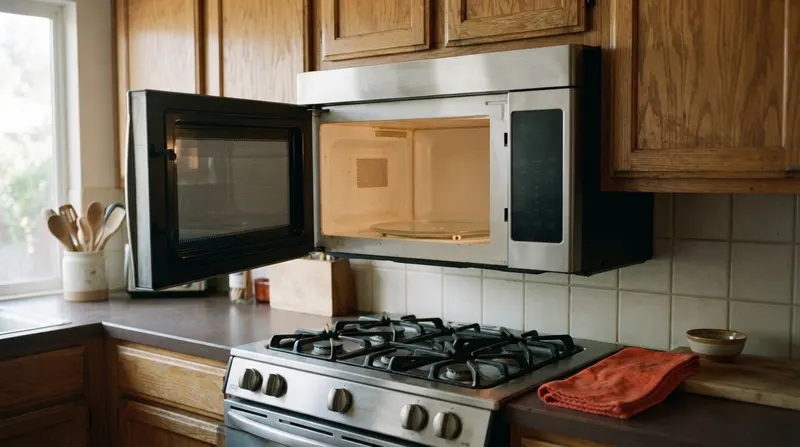
Microwave repair makes sense for the models that are hard to replace. An over-the-range unit doubles as the range hood, bolts to the wall and upper cabinet, and may be ducted outdoors. A built-in model sits in a trim kit sized for one opening. Replacing either means paying for installation on top of the unit, and more again if the new one needs electrical, venting or cabinet changes.
| What the microwave does | What the tech checks | Usual repair |
|---|---|---|
| Runs, lights up, but food stays cold | The high-voltage circuit, after discharging the capacitor: magnetron, diode, capacitor and fuse. | One of those parts replaced. Stop using it until then. |
| Sparks or flashes inside | The waveguide cover for burn marks and the cavity walls for holes or peeling coating. | A new waveguide cover. A hole in the cavity wall ends the microwave's life. |
| Door won't latch, or it starts with the door open | The latch hooks, the door alignment and each door switch. | Door switches or the latch assembly. Consumer Reports members report door problems among the most common. Don't use it meanwhile. |
| Keypad ignores presses | The membrane keypad and its ribbon connection, then the control board. | A new keypad or control board. |
| Vent fan weak, smoke hangs over the range | The fan motor, the grease and charcoal filters and the exhaust damper. | A fan motor or damper, or new filters where clogged. |
Costs
Pricing a Cooktop or Microwave Repair
National Consumer Reports figures; no local survey exists. The written price for your repair is the number that counts.
| Appliance | Typical figure | What moves the price |
|---|---|---|
| Gas cooktop repair (median paid) | $153 | Igniters, switches and burner parts are inexpensive. |
| Radiant glass cooktop repair (median paid) | $192 | A new glass panel costs far more than an element or switch. |
| Induction cooktop repair (median paid) | $536 | Generator boards and touch controls are the costly parts. |
| Installing a replacement over-the-range microwave | $100 to $200 | More if wiring, venting or the cabinet has to change. |
Consumer Reports' advice differs by type. It says it always makes sense to repair an expensive cooktop, and leans toward fixing gas models, while a cheap electric cooktop with a costly fault is often better replaced. On a microwave, a door switch sits at the low end and a magnetron or control board at the high end.
The visit
Getting a Cooktop or Microwave Fixed
-
Tell us what it's doing
Which appliance, the brand, the model number and the symptom: no spark, a crack, a flashing burner, no heat. If it's still under warranty, say so.
-
We get a tech out
Tell us how urgent it is, for instance if the cooktop is your only way to cook.
-
A written price first
You'll have a written price before the repair starts. California requires a written estimate; the cost guide explains what it covers.
-
Parts, then cooking again
Glass panels, generator boards and magnetrons are often ordered for the exact model, so some repairs finish on a second visit.
Where the model number is
On a cooktop, the label is usually on the underside, where you can see it from the cabinet below. On a microwave, open the door and check the frame around the opening. Read us the model number and the brand on both if the microwave sits over a range.
Brands and areas
Cooktop and Microwave Brands, and the Areas We Cover
Microwave brands often differ from the range beneath them. Cooktop and microwave makers include:
We cover central Sacramento, Natomas, Roseville, Rocklin, Carmichael and West Sacramento, among others. See every covered ZIP code. Don't see your ZIP? Call anyway and we'll check your address.
Questions
Cooktop and Microwave Repair Questions
Is a countertop microwave worth repairing?
Rarely. Consumer Reports prices small countertop models from about $60 and most midsized ones at $100 to $500, so most repairs pass its line for replacing: more than half the price of a new one.
Can I use the oven under a cracked glass cooktop?
GE advises against it. On a range, the oven vents onto the cooktop surface. Leave both off until the glass is replaced, and tell us the model when you call.
Why does my over-the-range microwave fan turn on by itself?
Usually it is protecting itself. Many over-the-range models switch the vent fan on when the burners below get hot, and it runs until the area cools. A fan that runs with the cooktop cold, or won't turn off at all, points to a sensor or the control board.
My microwave turntable stopped turning. Is it still safe to use?
Usually, if it still heats and the door closes properly. A stopped turntable most often means a worn drive motor or coupler under the tray, and food heats unevenly until it's fixed. Sparks, a loose door or no heat are reasons to stop using it.
Talk to us about the cooktop or microwave
Tell us which appliance it is and what it does when you switch it on. We'll set up a visit from an appliance tech.
Call (916) 618-0484